
Chery QQ3 EV India Launch 2026 – India’s EV market has been crying out for a genuinely affordable, genuinely feature-rich electric hatchback. The BYD Seagull was teased, the Citroen eC3 exists but remains basic, and the Tata Tiago EV continues to dominate for want of proper competition. Now, a new challenger has arrived — and its name is the Chery QQ3 EV.
Just two weeks ago, on March 30, 2026, Chery officially launched the all-new third-generation QQ3 EV in China. Within two hours of the launch event ending, the brand reported a staggering 56,879 orders — making it one of the most successful EV launches in China this year. And now, as of April 13, 2026, the QQ3 EV has been formally patented in India through Chery’s local partner, JSW Motors.
At a China starting price of CNY 58,900 — that is approximately Rs. 8.05 lakh at current exchange rates — the Chery QQ3 EV is potentially the most exciting, most disruptive affordable EV that India has never seen. But will it actually come here? And if it does, what do you get for the money? TorqueCulturee has done the full research.
JSW Motors and Chery
To understand why the Chery QQ3 EV patent in India is significant, you need to understand the JSW-Chery partnership — one of India’s biggest automotive stories of 2026.
JSW Motors, the independent automotive arm of the JSW Group founded by Sajjan Jindal, has partnered with China’s Chery Automobile to bring a range of New Energy Vehicles to India. This is a separate venture from JSW’s existing stake in MG Motor India. JSW has committed $2–3 billion over five years to this initiative and is building a 500,000-unit-per-year greenfield manufacturing plant in Chhatrapati Sambhajinagar, Maharashtra.
The first product from this partnership is already confirmed: a locally assembled version of the Chery Jetour T2 PHEV SUV, expected to launch before Diwali 2026 in the Rs. 15–40 lakh range, competing against the Toyota Fortuner and Tata Safari. The QQ3 EV patent, filed just weeks after the car’s Chinese debut, suggests that JSW and Chery are thinking about a much more affordable product for the mass market — possibly as a second or third product in their India lineup.
Design: Cute, Compact, and Surprisingly Substantial
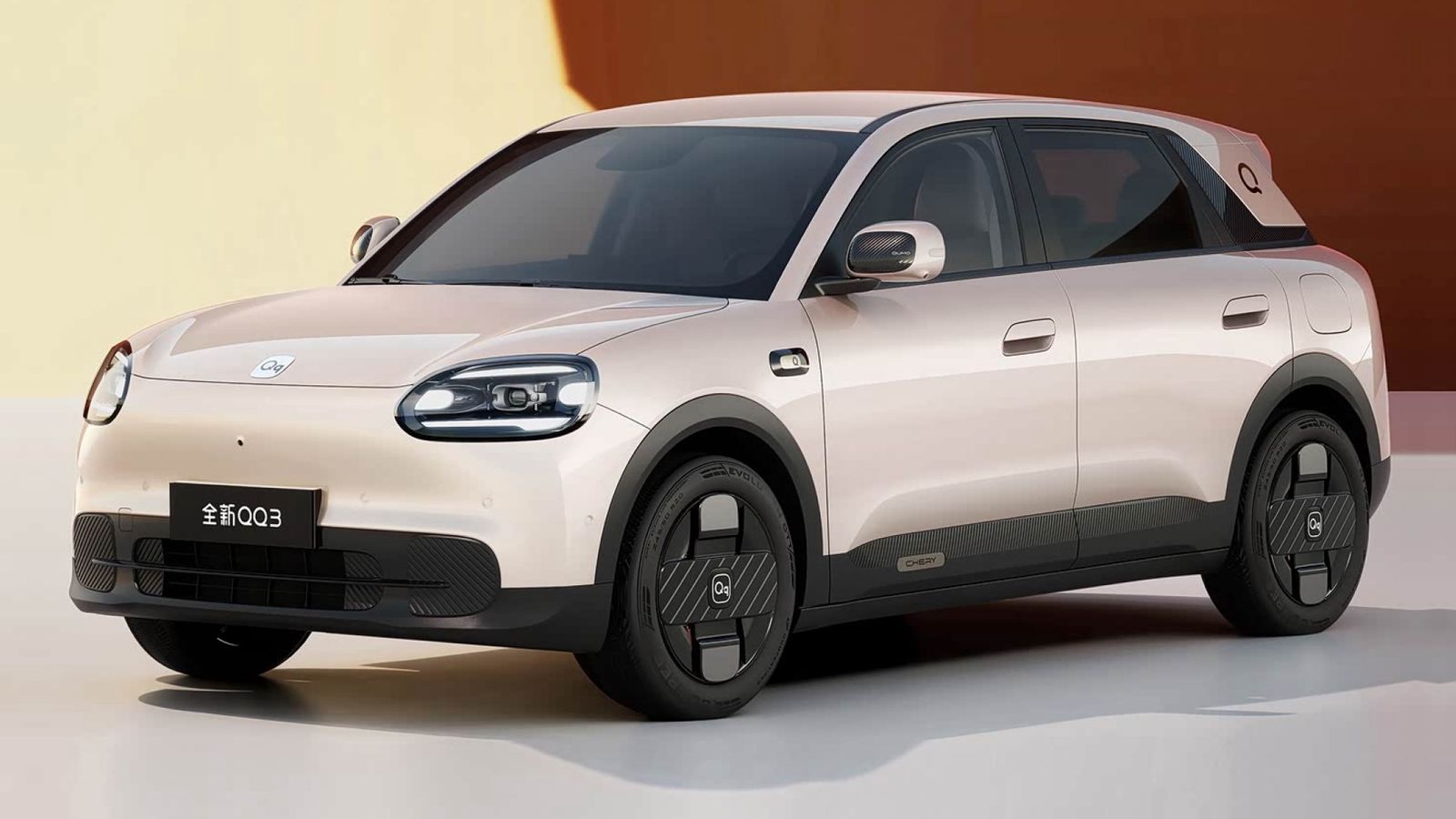
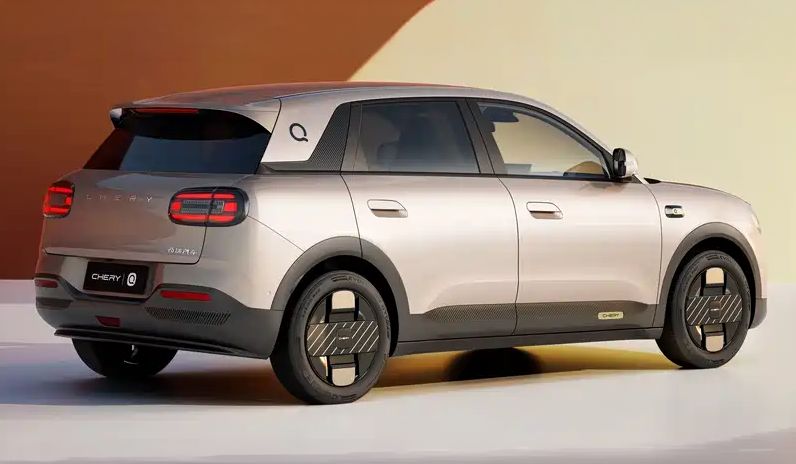
The new QQ3 EV is built around what Chery calls a ‘square within round’ design philosophy. The overall silhouette is rounded and charming — deliberately nostalgic — but loaded with modern details. The front features distinctive Q-shaped LED headlights (a direct nod to the original QQ logo), a fully closed grille typical of EVs, and a sculpted bonnet.
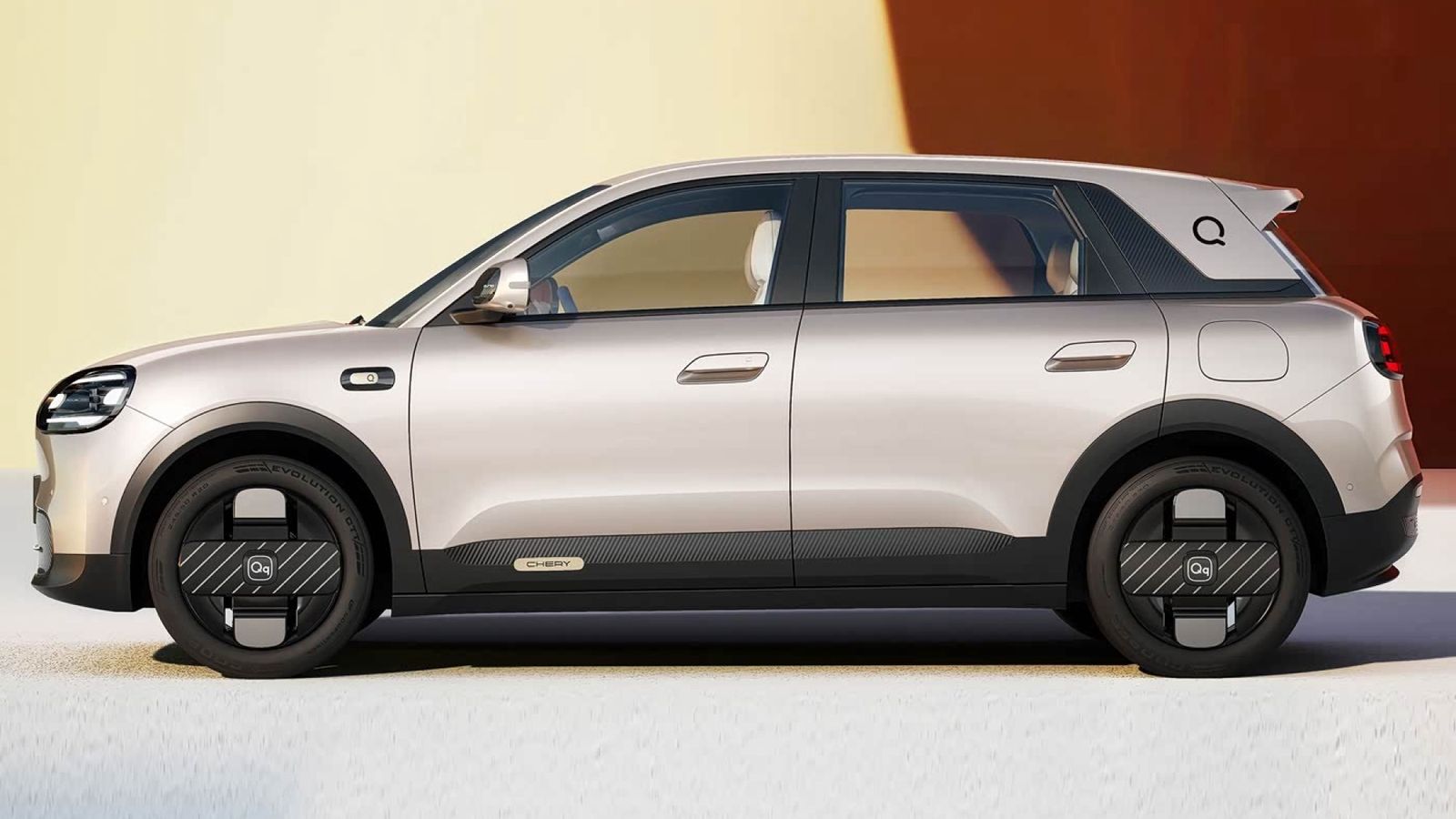
The side profile reveals semi-flush door handles, a strong character line, and a forward-leaning C-pillar that gives the car a sporty stance. The rear features a full-width LED light bar, a high-mounted brake light, and a large roof spoiler for visual drama. Available in multiple two-tone colour combinations, the QQ3 EV is designed to appeal to young, urban buyers — particularly first-time car owners.
Despite its compact appearance, the numbers are genuinely impressive. At 4,195 mm long and 1,811 mm wide with a 2,700 mm wheelbase, the QQ3 EV is actually larger than the Tata Tiago EV (3,769 mm) and comparable in footprint to the Maruti e-Vitara’s smaller variants. That extra size is not wasted — it goes straight into cabin space.
Full Specifications: What the Chery QQ3 EV Packs
Platform | T12 Native Intelligent Pure Electric |
Body Style | 5-Door Electric Hatchback |
Dimensions (L x W x H) | 4,195 mm x 1,811 mm x 1,573 mm |
Wheelbase | 2,700 mm |
Battery Options | 29.48 kWh (LFP) / 41.28 kWh (LFP) |
CLTC Range | 310 km (29.48 kWh) / 420 km (41.28 kWh) |
Motor Layout | Rear-Mounted, Rear-Wheel Drive (RWD) |
Motor Power Options | 58 kW (77 bhp) / 90 kW (120 bhp) |
Peak Torque | 90 Nm / 115 Nm |
Fast Charging (30%–80%) | Under 16.5 minutes |
V2L Capability | 3.3 kW and 6.6 kW output |
Front Trunk (Frunk) | 70 litres |
Boot Space | 375 litres (expandable to 1,450 L) |
Body Structure | 72% high-strength steel, 19% hot-stamped steel |
Torsional Rigidity | 27,000 N·m/deg |
Battery IP Rating | IP68 (35 cm submersion for 48 hours) |
ADAS System | Falcon 500 (optional) — 80 TOPS, Horizon J6E chip |
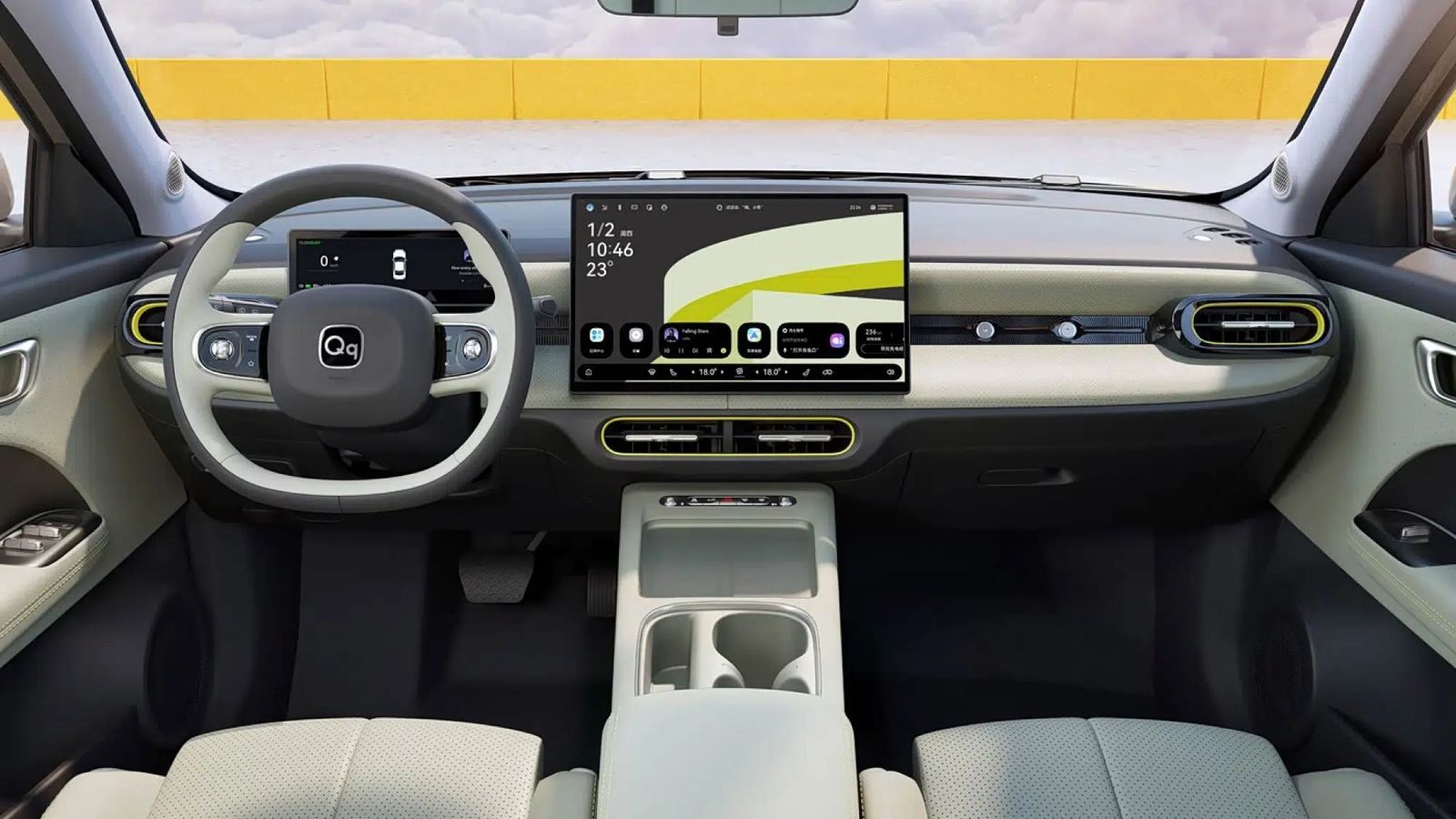
Infotainment | 15.6-inch 2.5K touchscreen, Qualcomm Snapdragon 8155 |
Instrument Cluster | 8.8-inch digital display |
Wireless Charging | 50W |
China Starting Price | CNY 58,900 (~Rs. 8.05 lakh) |
China Top Price | CNY 78,900 (~Rs. 10.78 lakh) |
Reasons the Chery QQ3 EV Would Be a Game-Changer in India
1. Rear-Wheel Drive on a Budget EV — A First in India
Every affordable EV sold in India today — the Tata Tiago EV, Tata Nexon EV, MG Comet, Citroen eC3 — uses a front-wheel-drive layout. The Chery QQ3 EV uses a rear-mounted motor with rear-wheel drive. This is significant. RWD gives the car better weight distribution, sharper handling, and a more engaging driving character. It is a layout typically associated with sports cars and premium EVs, not budget hatchbacks. At Rs. 8 lakh equivalent, this would be genuinely unprecedented in India.
2. A 15.6-Inch Snapdragon 8155 Screen in a Sub-10 Lakh Car
The Chery QQ3 EV’s cabin is dominated by a 15.6-inch 2.5K resolution touchscreen powered by the Qualcomm Snapdragon 8155 chip — the same processor used in flagship smartphones and premium EVs like the BYD Atto 3. It supports the ‘AI Lingxi’ intelligent cockpit with wake-word-free voice control, CarPlay, and HiCar. There are 35 storage compartments inside the cabin and a seat with under-cushion storage. For context, the Maruti e-Vitara — which starts at Rs. 13.49 lakh — gets a 10.25-inch infotainment screen. The QQ3 EV’s interior would be in a different universe at its price point.
3. 420 km Range and 16-Minute Fast Charging
The larger 41.28 kWh LFP battery offers a CLTC-certified range of 420 km. Adjusted for real-world Indian conditions (CLTC is typically optimistic), a realistic range of 320–360 km per charge would still be exceptional at this price. Fast charging from 30% to 80% takes under 16.5 minutes. The car also supports Vehicle-to-Load (V2L) functionality, meaning it can power external devices at 3.3 kW or 6.6 kW — useful for camping, power outages, and more. The Tata Nexon EV, which costs significantly more, offers 465 km MIDC range without V2L in its base variant.
4. Safety Architecture That Punches Above Its Class
The QQ3 EV’s body is built on a cage-style structure with 72% high-strength steel and 19% hot-stamped steel, giving it a torsional rigidity of 27,000 N·m/deg — a figure that rivals many mid-segment sedans. The battery pack carries an IP68 rating, certified for 48-hour submersion at 35 cm depth. The optional Falcon 500 ADAS suite with 80 TOPS of computing power supports highway navigation assist, automated parking across 100+ scenarios, and urban driving assistance. Safety at this price would be a significant differentiator in the Indian market.
5. A Frunk, Massive Boot, and Real-World Practicality
Most EVs in India offer only a boot. The QQ3 EV also gives you a 70-litre front trunk (frunk), thanks to the rear motor layout. Combined with a 375-litre rear boot that expands to 1,450 litres with the seats folded, total storage capacity is exceptional. There are also 6-way power-adjustable front seats with memory and ventilation, and 35 dedicated storage compartments inside the cabin.
How It Would Stack Up Against Indian EVs
Model | Price (ex-sh) | Range (Real) | Screen | Drive Layout |
Chery QQ3 EV* | ~Rs. 8–10 L* | ~320–360 km | 15.6″ 2.5K | Rear-Wheel Drive |
Tata Tiago EV | Rs. 8.19 L | ~250 km | 7″ | Front-Wheel Drive |
Tata Nexon EV | Rs. 12.49 L | ~330 km | 10.25″ | Front-Wheel Drive |
MG Comet EV | Rs. 7.98 L | ~200 km | 10.25″ | Front-Wheel Drive |
Maruti e-Vitara | Rs. 13.49 L | ~380 km | 10.25″ | Front-Wheel Drive |
* Estimated India price. Not officially confirmed. China price ~Rs. 8–10.78 lakh.
What Will the Chery QQ3 EV Cost in India?
This is where it gets complicated — and honest. The China price of Rs. 8–10.78 lakh is not what you will pay in India. The Indian government levies 100% customs duty on fully imported (CBU) vehicles, which would effectively double the price before any dealer margins or taxes. However, JSW Motors is building a local assembly plant in Maharashtra, and if the QQ3 EV is assembled there as a CKD (Completely Knocked Down) unit — which is the route JSW is taking for its other Chery products — duties come down dramatically.
EVs in India also benefit from 5% GST (versus 28% for petrol cars), and the PM E-DRIVE scheme offers additional incentives for locally assembled EVs. Assuming JSW achieves 40–50% localisation at launch, a realistic India on-road price for the QQ3 EV base variant (310 km, 77 bhp) could be in the Rs. 11–14 lakh range, with the top 420 km variant potentially landing at Rs. 14–16 lakh.
That would still make it one of the most feature-rich and performance-forward EVs available in India at that price band, undercutting the Tata Nexon EV while matching or exceeding it on screen size, ADAS capability, boot space, and driving dynamics.
Chery QQ3 EV India Launch: What’s the Timeline?
Based on all available information, here is a realistic timeline breakdown:
- March 30, 2026: Chery QQ3 EV officially launched in China. 56,879 orders in two hours
- April 13, 2026: Chery QQ3 EV officially patented in India — a strong indicator of launch intent
- 2026 (Diwali): JSW’s first India product (Jetour T2 PHEV) expected to launch. This establishes the dealer and service network
- 2027 (expected): JSW’s second or third product — potentially the QQ3 EV — could follow as JSW expands into the mass-market segment
The QQ3 EV India launch is unlikely before 2027, given that JSW is still building its dealer network and local manufacturing capacity for its first (much more expensive) vehicle. But the patent filing signals that Chery and JSW are thinking about this product for India, and when it comes, it will be worth the wait.
Challenges: What Could Hold It Back?
- India-China trade sensitivities: Importing components from China faces government scrutiny. JSW has already faced delays on its Jetour T2 for this reason
- Localisation requirements: PM E-DRIVE and FAME subsidies typically require 50%+ local content. Achieving this quickly is a challenge for a new brand
- Service network: Chery and JSW are starting from zero in India. A nationwide service network will take years to build to the standard buyers expect
- NCAP safety testing: The QQ3 EV’s India-spec will need BNCAP testing. Given the car’s strong body structure, this should not be a problem — but it takes time
- Competition: By the time the QQ3 EV launches in India, Tata, Mahindra, and others will have updated their affordable EV offerings
TorqueCulturee Verdict: Should You Be Excited?
Absolutely — with measured expectations. The Chery QQ3 EV is a genuinely exceptional product on paper. A rear-wheel-drive electric hatchback with a 420 km battery, a 15.6-inch Snapdragon 8155 screen, a 70-litre frunk, IP68 battery protection, and ADAS capability — all in a sub-Rs. 10 lakh equivalent package — is the kind of specification that would turn India’s affordable EV segment on its head.
The patent filing in India is the clearest sign yet that this car is on Chery and JSW’s radar for the Indian market. If JSW can bring it here at Rs. 12–14 lakh with solid local assembly, a good warranty, and a growing service network, the Chery QQ3 EV could be the Tata Tiago EV’s most dangerous competitor since the Tiago EV itself launched.
The bottom line: Watch this space. The Chery QQ3 EV’s India patent is not a launch — but it is a promise. And it is a promise worth paying attention to.
TorqueCulturee will track all developments on the Chery QQ3 EV India launch, pricing, and specifications. Bookmark this page and follow us for the latest updates.
for more details stay tuned at torqueculturee.com
You can also read : Upcoming Toyota Cars in India
Related posts:
- Best Diesel Cars Under 10 Lakh in India 2026: High Mileage, Strong Torque, Real Value
- Volkswagen Taigun 2026 Facelift Revealed in India – Here are All Details
- Maruti e-Vitara vs Tata Sierra EV – Which Electric SUV Should You Buy in 2026?
- Renault Triber 2026 India – Updated Design, More Features & Still the Most Affordable 7-Seater
- Hyundai’s New Budget Electric SUV Spotted Testing in India – Creta EV Rival in the Making?